Why a Copied Trader and a Copier Can Have Different Results
Inspect allocation, rounding, timing, open positions and account constraints before assuming a displayed trader return transfers to your account.
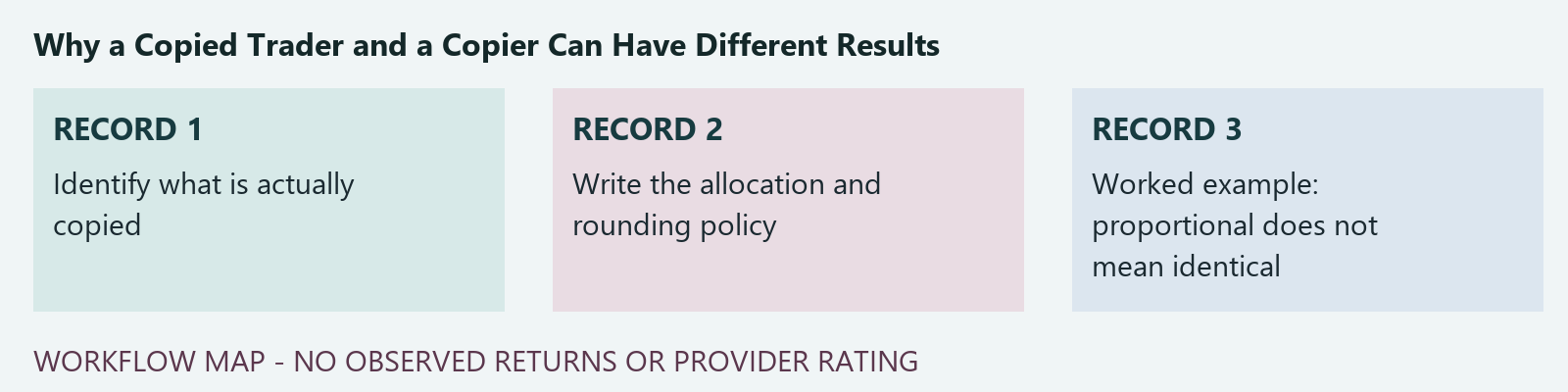
Identify what is actually copied
The service may mirror orders, target weights, position changes or another instruction type. Record the exact mechanism and product rather than assuming all copy trading behaves alike. Identify account type, broker, instruments, currency and regional access. A public trader profile is not an account-level guarantee for the copier. Keep the source trader's reported record, the platform's displayed convention and the copier's actual account trail distinct so a comparison does not borrow evidence across different objects.
Write the allocation and rounding policy
Record minimum order size, lot increments, allocation base and how cash flows change future copies. A proportional target can become a different exposure after rounding or when a small order is skipped. Retain unavailable instruments and rejected requests rather than pretending they were copied successfully. Do not invent current platform thresholds. The actual terms and instrument specifications govern a real account, while the worksheet should flag unknown rules as unanswered questions.
Worked example: proportional does not mean identical
Invent a source allocation implying a 0.3-unit position for a copier, while a fictional instrument permits whole-unit quantities only. Rounding down creates no position; rounding up creates one unit, more than three times the intended quantity. A platform might instead skip, pool or use a different product, but that needs its own documented mechanism. The example is a unit constraint fixture, not a current copy-service policy or recommendation. Similar source percentages cannot resolve the missing allocation and execution rule.
Keep timing and order state on the record
Source publication, copier receipt, account request, acceptance and fill can happen at different times and prices. SEC order guidance explains why a price instruction differs from execution; a copy platform's exact broker integration still needs its own evidence. An amendment can arrive while an earlier request is partially filled. Preserve the account's resulting exposure instead of labelling every source change a completed copied action. A source trader closing a position does not prove all copiers closed simultaneously.
Inspect existing positions and cash movements
Ask whether joining copies positions already open or only subsequent actions, and how withdrawals, deposits or stopping access affect holdings. Funding, currency conversion, margin and financing can differ between source and copier. A fund or personal-account credential does not authenticate the displayed copy product. Performance-reporting standards provide scope concepts, not a compliance claim for the platform. Keep the denominator and reporting cutoff visible before comparing returns which may use different cash-flow or open-equity conventions.
Review fit without promising transferability
A useful comparison documents the mechanism, eligibility, allocation rules, cost stack, evidence status and exit from the arrangement. It does not infer future copier returns from a source leaderboard. No account was connected or paid copy service tested by this guide. The blank divergence register helps a reader locate why two records differ and which source could resolve each gap. A legitimate service can still be unsuitable when its supported products, minimum quantities or operational rules do not match the copier's account and understanding.
Decision record
| Question | Record to retain | Decision boundary |
|---|---|---|
| Mechanism | Order, position or target-weight copying definition | Different mechanisms are not interchangeable |
| Allocation | Base, increments and skipped-order policy | Proportional targets can fail minimum-size constraints |
| Execution | Receipt, request, fill and amendment trail | Source action is not simultaneous copier action |
| Account | Open-position and cash-flow treatment | Trader and copier returns can describe different objects |
Blank working record
The worksheet contains column headings only. Enter your own dated observations, keep absent evidence marked unknown, and do not treat the file as certification.
 Download worksheet (CSV)
Primary references
- SEC: order types and execution limitations
- CFA Institute: GIPS standards and scope
- FTC: endorsements and reviews
These documents support mechanisms and source definitions, not a tested trading result or a recommendation. Accessed 9 October 2026. The decision workflow and invented examples above are editorial exercises.
Keep reading
Publication methodology | Working glossary | Source and correction policy
Keep static rounding and observed coverage distinct
The retained allocation-divergence guide remains. Its static rounding illustration is a declared arithmetic scenario, not a broker fill. The new coverage ledger instead accepts independent intended and observed notional rows with explicit statuses.
Neither mechanism can authenticate an instrument map or detect omitted actions. The new journal groups caller-declared common-unit values but does not net positions or convert currencies. A zero intended denominator stays null. Unknown observation stays null rather than becoming a skipped row. These conventions help a buyer inspect which question a comparison can answer. The original formula and guide are not replaced by an untested copier or a new performance claim. Actual allocation policy and account permission still require their own authoritative sources.
Keep the record boundary
The authored journals are not empirical provider tests. A valid decimal result can still use an incomplete population or incompatible product definition. Keep the account card, mapping, period and source coverage with the interpretation. The tool cannot authenticate an observation, discover omitted events or choose a causal explanation for divergence. Original personal and provider claims remain unchanged. No new participant result or user-review aggregate is invented to make the comparison look stronger.
A comparison is not account management
Unknown fills remain null, observed zero stays a separate state, and below/above amounts retain their identities. A paired price-cost sum is not an investment return. The journals keep broker reconciliation, strategy validation and suitability null. They send no orders and change no native policy. A useful closeout states the supplied population and unresolved question rather than grant permission, recommend an allocation or promise that copying reproduces a leader's history.